How to Calculate Construction Grade Sand for a Paver Project
How to Calculate Construction Grade Sand for a Paver Project | Jurupa Valley | Mr. Pavers Garden & Supply
Build a Stable Paver Base with the Right Sand Amount
Accurate sand calculations help us avoid one of the most frustrating paver problems, an uneven finished surface. Too little material can make leveling difficult, while too much can create extra labor, waste, and unnecessary leftovers. The right amount of construction-grade sand supports a smoother installation for patios, walkways, driveways, and outdoor living areas.
Before ordering, we need the project length, width, planned sand depth, and an understanding of how compaction will affect that depth. The process is simple once the measurements are clear: find the area, calculate volume in cubic feet, convert it to cubic yards, and allow for normal jobsite waste.
Know Where Construction-Grade Sand Fits in the Base
Construction-grade sand is a dependable aggregate material used for a range of hardscaping and site-preparation needs. The right type of sand depends on its job. Sand placed beneath pavers is different from sand swept into the joints after installation, and neither should be chosen by name alone.
For most paver installations, we recommend thinking of the foundation as a system with separate layers:
- Compacted sub-base aggregate for strength and support
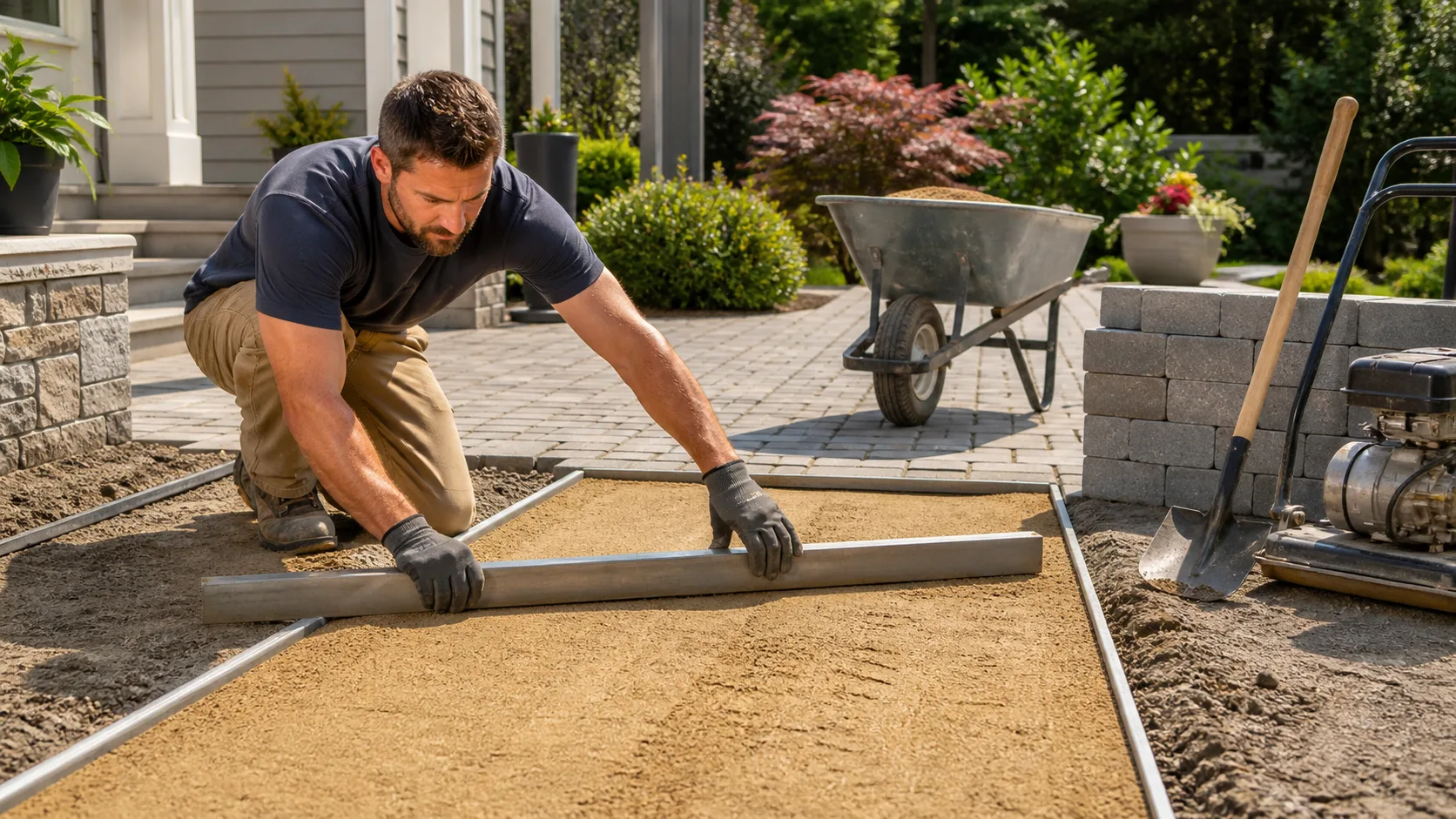
- A thin construction-grade sand bedding layer for leveling
- Pavers placed over the prepared bedding layer
- Jointing material to fill the gaps between pavers
The bedding layer gives each paver a consistent setting surface. It is not meant to replace a properly prepared gravel base, especially where vehicles, heavy outdoor features, weak soil, or drainage concerns are involved. A driveway, for example, often needs more support below the sand than a simple footpath.
Joint sand has a separate purpose. It fills the spaces between finished pavers, helping them stay aligned and creating a completed appearance. Since materials vary by application, we encourage you to confirm the right sand, aggregate, and jointing material before finalizing a project plan.
Measure Your Paver Area and Bedding Layer Depth
Start with the finished paver area, not just a rough estimate from the original sketch. For a rectangle, multiply the length by the width to find square footage. A 20-foot by 15-foot patio, for example, covers 300 square feet.
Curved or irregular spaces take a little more thought. We often suggest breaking the layout into smaller, easy-to-measure shapes, then adding the results together. This gives you a much more useful number than guessing around curves and angles.
- Rectangle: length × width
- Triangle: base × height, then divide by 2
- Circle: radius × radius × 3.14
- Irregular area: add the square footage of smaller shapes
Next, decide on the bedding layer depth. A typical paver bedding layer is often about 1 inch deep after compaction, although project plans, paver styles, and site conditions can call for something different. Since the rest of the formula uses feet, convert inches to feet before moving on. One inch divided by 12 equals about 0.083 feet.
For that 300-square-foot patio, multiply 300 by 0.083. The result is about 25 cubic feet of sand after compaction, before extra material is considered.
Convert Sand Volume Into Cubic Yards and Tons
Once we know the area and depth, the volume calculation is straightforward:
Length in feet × width in feet × depth in feet = cubic feet
If you already have the project’s square footage, multiply that number by the depth in feet. To change cubic feet into cubic yards, divide by 27. Bulk sand is commonly measured in cubic yards, so this conversion helps us match the calculation to the way material may be ordered.
Using the 300-square-foot patio example, a 1-inch layer needs about 25 cubic feet of construction-grade sand. Divide 25 by 27, and the result is about 0.93 cubic yards.
Sand may also be sold by the ton or in bags. Weight can change based on moisture and the material itself, so we recommend confirming the estimated weight per cubic yard before converting cubic yards into tons. That small step can prevent an order from being based on an unreliable guess.
For a larger patio, driveway, walkway, or outdoor area, bulk material is often easier to manage than many individual bags. Bags can make sense for small repairs or spaces where bulk delivery and placement are limited. Either way, it is usually smarter to round up rather than down.
Adjust Your Construction-Grade Sand Order for Real Conditions
The calculation gives us a strong starting point, but jobsite conditions can change the final amount. Sand compacts when it is spread and leveled. Some may also be lost during grading, moved into low spots, or left behind during cleanup.
For many paver projects, we suggest adding about 5 to 10 percent extra construction-grade sand. A larger allowance may be needed when the layout includes curved edges, slopes, uneven excavation, or more grading work than expected.
Material needs can rise when:
- The excavated area has low spots or changing depths
- The bedding layer must be thicker in certain areas
- The project has curves, borders, or angled cuts
- Access is limited, making additional material harder to bring in
Each part of a paver project should be calculated separately. Base rock, pavers, edge restraints, geotextile fabric, jointing sand, and drainage materials all serve different purposes and have their own coverage rates. We recommend checking measurements again after excavation, since the actual prepared area can differ from the original plan.
Plan Your Material List Carefully
A reliable paver foundation starts with clear measurements and the correct material for each layer. Measure the area, choose the proper bedding depth, calculate cubic feet, convert to cubic yards, and include extra for compaction and normal site adjustments.
Careful planning keeps the installation moving and helps the finished pavers sit evenly over a properly prepared base. When in doubt, verify the measurements and material type before placing an order, especially for driveways, drainage-sensitive areas, and projects with changing grades.
Get the Right Materials for Your Paver Base
At Mr. Pavers, we make it easier to source dependable construction-grade sand for your paver project. Our team can help you choose materials that suit your base preparation and installation needs. If you have questions before ordering, contact us for helpful guidance.